


Influencing Factors and Functions of Primary School Students' Safety Literacy: A Multilevel Structural Equation Model Analysis Based on the Four-Factor Theory
-
摘要: 研究从四因素理论视角出发,基于H省7市28所小学学生安全素养问卷调查数据,运用Mplus8.0软件构建多层结构方程模型,分析小学生安全素养的影响因素及其彼此作用。研究发现,气质情绪特性、安全学习能动性、安全环境与学校安全教育四因素均对小学生安全素养产生显著的正向影响,影响力从大到小依次是学校安全教育、家庭安全环境、安全学习能动性、气质情绪特性;四因素在单独产生影响的同时,还彼此相互作用,安全环境和学校安全教育通过发展小学生气质的积极特性来间接影响其安全素养,安全学习能动性是其他三个因素与小学生安全素养之间的中介变量。基于研究发现,提出了完善小学生安全素养“学校-家庭-社区”协同培育机制、充分激发小学生的安全学习能动性和有效开展个性化小学生安全素养培育等对策建议。Abstract: From the perspective of the four-factor theory, this paper constructs a multilevel structural equation model with Mplus 8.0 software based on questionnaire survey data on primary school students' safety literacy collected from 28 primary schools across seven cities in Province H in 2019, and analyzes the influencing factors of primary school students' safety literacy and their interactive effects. The study finds that four factors, namely temperamental emotional characteristics, safety-learning initiative, safety environment and school safety education, all exert significant positive effects on primary school students' safety literacy. The influence magnitude in descending order is school safety education, family safety environment, safety-learning initiative, community safety environment, and temperamental-emotional characteristics. While exerting independent influences, the four factors also interact with one another. Safety environment and school safety education indirectly affect students' safety literacy by fostering their positive temperamental characteristics, and safety-learning initiative serves as a mediating variable between the other three factors and primary school students' safety literacy. Based on the research findings, this paper puts forward countermeasures and suggestions including improving the "school-family-community" collaborative cultivation mechanism for primary school students' safety literacy, fully enhancing primary school students' safety-learning initiative, and implementing personalized cultivation of primary school students' safety literacy.
-
表 1 MCFA模型适配度检验
卡方自由度比 比较拟合指数 非规范拟合指数 近似误差均方根 均方根残差-组内 均方根残差-组间 建议标准值 < 5 ≥.9 ≥.9 ≤.08 < .1 < .1 模型实际值 2.73 .976 .971 .024 .030 .018 符合程度 较好 较好 较好 较好 较好 较好  下载: 导出CSV
表 2 各量表的信度与收敛效度检验结果
因子载荷Factor loading 题目信度R-square (SMC) 残差(1-SMC) 组成信度CR 收敛效度AVE 组内 安全意识 .568~.657*** .323~.431*** .569~.677 .717 .389 安全知识 .638~.793*** .408~.629*** .371~.592 .736 .484 安全能力 .579~.729*** .335~.531*** .469~.665 .753 .434 (二阶)安全素养 .640~.882*** .409~.778*** .222~.591 .784 .552 安全学习能动性 .642~.724*** .412~.524*** .476~.588 .712 .453 家庭安全环境 .585~.708*** .342~.501*** .499~.658 .669 .405 社区安全环境 .646~.699*** .418~.488*** .512~.582 .767 .452 组间 学校安全教育 .888~.917*** .789~.842*** .158~.211 .944 .809 注:“***”表示通过0.001显著性水平检验。
下载: 导出CSV
表 3 小学生安全素养整体得分情况(N=2885)
平均值 得分率 最小值 最大值 标准差 方差 小学生安全素养 安全意识 4.453 89.06% 2.00 5.00 0.579 0.336 安全知识 4.643 92.86% 1.67 5.00 0.484 0.234 安全能力 4.370 87.04% 1.50 5.00 0.627 0.393 小学生安全素养总得分 4.490 89.80% 2.00 5.00 0.438 0.192
下载: 导出CSV
表 4 小学生安全素养影响因素的MSEM模型分析结果
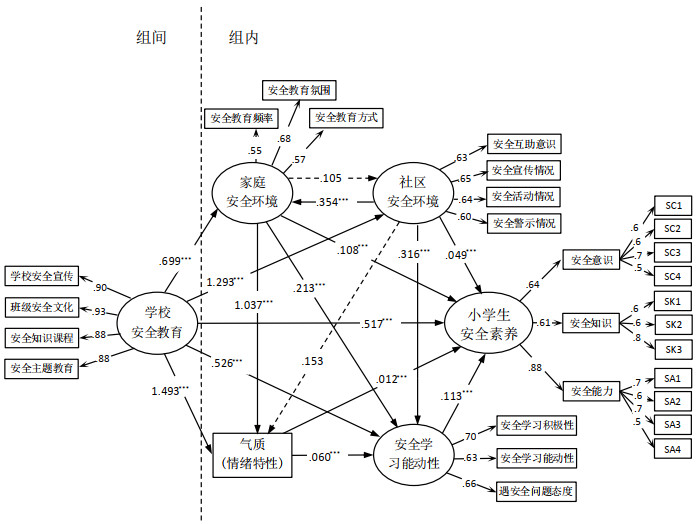
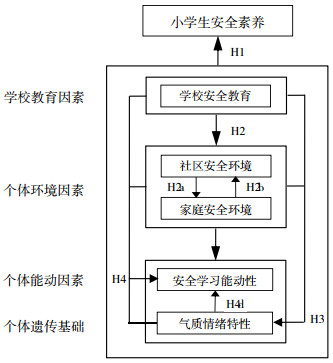
MSEM模型 假设检验 组内 组间 安全素养ON 气质(情绪特性) .012**(.004) H1a成立 安全学习能动性 .113***(.018) H1b成立 家庭安全环境 .108***(.028) H1c成立 社区安全环境 .049**(.018) H1d成立 学校安全教育 .517***(.111) H1e成立 气质(情绪特性) ON 家庭安全环境 1.037***(.151) H3c成立 社区安全环境 .153(.113) H3b不成立 学校安全教育 1.493***(.335) H3a成立 安全学习能动性ON 气质(情绪特性) .060***(.012) H4d成立 家庭安全环境 .213***(.060) H4c成立 社区安全环境 .316***(.052) H4b成立 学校安全教育 .526**(.188) H4a成立 家庭安全环境ON 社区安全环境 .354***(.074) H2a成立 学校安全教育 0.699***(.102) H2c成立 社区安全环境ON 家庭安全环境 .105(.284) H2b不成立 学校安全教育 1.293***(.141) H2d成立 模型拟合指标 卡方自由度比 1491.617/481=3.101 近似误差均方根 .027 比较拟合指数 .939 非规范拟合指数 .930 均方根残差-组内 .028 均方根残差-组间 .102 注:“***”“**”“*”分别表示通过0.001、0.01和0.05显著性水平检验;括号内为稳健标准误差。
下载: 导出CSV
表 5 四因素对小学生安全素养间接影响路径检验结果
间接影响路径 间接路径系数a 95%置信区间 是否显著 占总系数c比值 下限 上限 学校安全教育对小学生安全素养 PSE1.PSE-SSE-FSE-TEN-SLI-SL .003(.001) .001 .005 是 .34% PSE2.PSE-SSE-FSE-SLI-SL .011(.004) .004 .018 是 1.24% PSE3.PSE-SSE-FSE-SL .050(.014) .026 .073 是 5.66% PSE4.PSE-SSE-SLI-SL .046(.013) .025 .067 是 5.20% PSE5.PSE-FSE-TEN-SLI-SL .005(.001) .003 .007 是 .57% PSE6.PSE-FSE-TEN-SL .009(.003) .004 .014 是 1.02% PSE7.PSE-FSE-SLI-SL .017(.006) .007 .026 是 1.92% PSE8.PSE-TEN-SLI-SL .010(.003) .006 .015 是 1.13% PSE9.PSE-SSE-SL .063(.025) .021 .105 是 7.13% PSE10.PSE-FSE-SL .076(.025) .035 .116 是 8.6% PSE11.PSE-TEN-SL .018(.006) .009 .028 是 2.04% PSE12.PSE-SLI-SL .059(.026) .016 .102 是 6.67% PSE-SL总间接路径系数b .367(.082) .232 .502 是 41.52% 社区安全环境对小学生安全素养 SSE1.SSE-FSE-TEN-SLI-SL .002(.001) .001 .004 是 1.49% SSE2.SSE-FSE-SLI-SL .009(.003) .004 .013 是 6.72% SSE3.SSE-FSE-SL .038(.011) .021 .056 是 28.36% SSE4.SSE-SLI-SL .036(.009) .021 .051 是 26.87% SSE-SL总间接路径系数 .085(.017) .057 .113 是 63.43% 家庭安全环境对小学生安全素养 FSE1.FSE-TEN-SLI-SL .007(.002) .004 .010 是 4.61% FSE2.FSE-TEN-SL .013(.005) .005 .020 是 8.55% FSE3.FSE-SLI-SL .024(.007) .013 .035 是 15.79% FSE-SL总间接路径系数 .044(.008) .031 .057 是 28.95% 气质(情绪特性)对小学生安全素养 TEN1.TEN-SLI-SL .007(.002) .004 .009 是 36.84% TEN-SL总间接路径系数b .007(.002) .004 .009 是 36.84% 注:a:间接路径系数值为该条中介路径中所含系数的乘积,如PSE-SSE-FSE-SL=1.293*.354*0.108=0.050;b:总间接路径系数为该自变量到因变量的所有间接路径系数之和;c:总系数为该中介路径的间接路径系数加该自变量到因变量的直接影响路径系数之和;d: SL代表小学生安全素养,PSE代表学校安全教育,SSE代表社区安全环境,FSE代表家庭安全环境,TEN代表气质(情绪特性),SLI代表安全学习能动性。
下载: 导出CSV
表 6 小学生安全素养影响因素的影响路径系数分析
影响路径 总系数值 直接影响路径系数 间接影响路径系数 系数值 比值 系数值 比值 学校安全教育-小学生安全素养 .884 .517 58.48% .367 41.52% 社区安全环境-小学生安全素养 .134 .049 36.57% .085 63.43% 家庭安全环境-小学生安全素养 .152 .108 71.05% .044 28.95% 气质(情绪特性)-小学生安全素养 .019 .012 63.16% .007 36.84% 安全学习能动性-小学生安全素养 .113 .113 100% / /
下载: 导出CSV
-
[1] 高山. 中国应急教育与校园安全发展报告2018[M]. 北京: 科学出版社, 2019: 11. [2] 中华人民共和国教育部. 2006年全国中小学安全形势分析报告[J]. 人民教育, 2007(8): 9-11. [3] Dougherty J, Pucci P, Hemmila M R, ea al. Survey of Primary School Educators Regarding Burn-risk Behaviors and Fire-safety Education[J]. Journal of the International Society for Burn Injuries, 2007 (4): 472-476. [4] 王道俊, 郭文安. 教育学[M]. 北京: 人民教育出版社, 2016: 33-42. [5] 徐文闻, 马治国. 生命安全素养的基本构成要素、形成路径及教育建议[J]. 教育科学, 2013 (1): 32-38. [6] Vallinkoski K, Koirikivi P. Enhancing Finnish basic Education Schools' Safety Culture through Comprehensive Safety and Security Management[J]. Nordic Journal of Studies in Educational Policy. 2020(6): 103-115. [7] 任国升, 孙善强. 大学生安全素养训练手册[M]. 保定: 河北大学出版社, 2011: 5. [8] 李少奇, 郑丽萍. 大学生安全素质培养研究[J]. 重庆大学学报(社会科学版), 2012 (3): 162-166. [9] 贺敏. 大学生安全素养实证研究: 以山西师范大学为例[D]. 临汾: 山西师范大学, 2015: 7. [10] Saudino K J, Micalizzi L. Emerging Trends in Behavioral Genetic Studies of Child Temperament[J]. Child Development Perspectives, 2015 (3): 144-167. [11] 高月霞. 对不同气质类型学生的能力培养研究[J]. 教育探索, 2011(2): 146-147. [12] 金佳漪. 基于气质类型的班级管理研究: 以小学低年级为例[D]. 上海: 上海师范大学, 2017: 19. [13] Bae S A, Noh S R, Ok S Y. An Exploratory Study of the Individual Characteristics Influencing the Safety Behavior of University Students[J]. Journal of the Korean Society of Safety, 2016(3): 102-108. [14] 程诗敏. 风险社会视域下大学生安全素质提升研究[D]. 北京: 首都师范大学, 2014: 100. [15] Wilson A. The Effect of Community Involvement Programs on School Violence[J]. Journal of Multidisciplinary Graduate Research, 2019(1): 1-11. [16] Kwon Y G. Pilot Study of Safety Education and Safety Awareness in Middle and High School Students[J]. Journal of Society of Korea Industrial and Systems Engineering, 2015(1): 30-43. [17] 刘玉照. 高职院校学生人身安全素养培育路径分析[J]. 福建教育学院报, 2018(7): 60-62. [18] 曲泽鸿. 当前大学生安全素质教育问题研究[D]. 扬州: 扬州大学, 2016: 43. [19] 韩金晶, 陆辰馨, 杜水云, 等. 趋近和抑制气质儿童的行为发展及其影响因素[J]. 应用心理学, 2020(3): 219-231. [20] 殷雷. 学习态度与学习成绩的相关研究——以学习考勤记录与课堂提问成绩作为学生平时成绩的初步探讨[J]. 心理科学, 2008(6): 1471-1473. [21] Kwon Y G. Pilot Study of Safety Education and Safety Awareness in Middle and High School Students[J]. Journal of Society of Korea Industrial and Systems Engineering, 2015(1): 30-43. [22] 梁海祥. 居住社区对青少年健康的影响[J]. 当代青年研究, 2019(4): 26-35. [23] Noghani F A, Moteallemi A, Alidadi H, et al. The Survey of the Environmental Health Status and Safety of Public and Non-Public Elementary Schools in Mashhad, Iran[J]. International Journal of Pediatrics, 2019(12): 523-532. [24] 翟晓磊, 李海鹏. 论学校在"校-家-社"关系中的主导地位——空间、权力和知识视角下学校、家庭和社区关系研究[J]. 中国教育学刊, 2020(11): 49-53. [25] 吴帆. 核心素养视野下小学生自主管理能力的调查研究: 以M小学为例[D]. 南京: 南京师范大学, 2019: 73-80. [26] 董新良, 刘艳, 关志康. 学校安全风险防控: 问题梳理与改进对策[J]. 中国教育学刊, 2019(9): 65-69+80. [27] 王孟成, 毕向阳. 潜变量建模与Mplus应用·进阶篇[M]. 重庆: 重庆大学出版社, 2018: 202. -

 点击查看大图
图(2) / 表(6)
计量
- 文章访问数: 4
- HTML全文浏览量: 0
- PDF下载量: 1
- 被引次数: 0